
LBMP–079: Les Manuscrits Caumont: II Orgue (Second Edition)

From €38.00
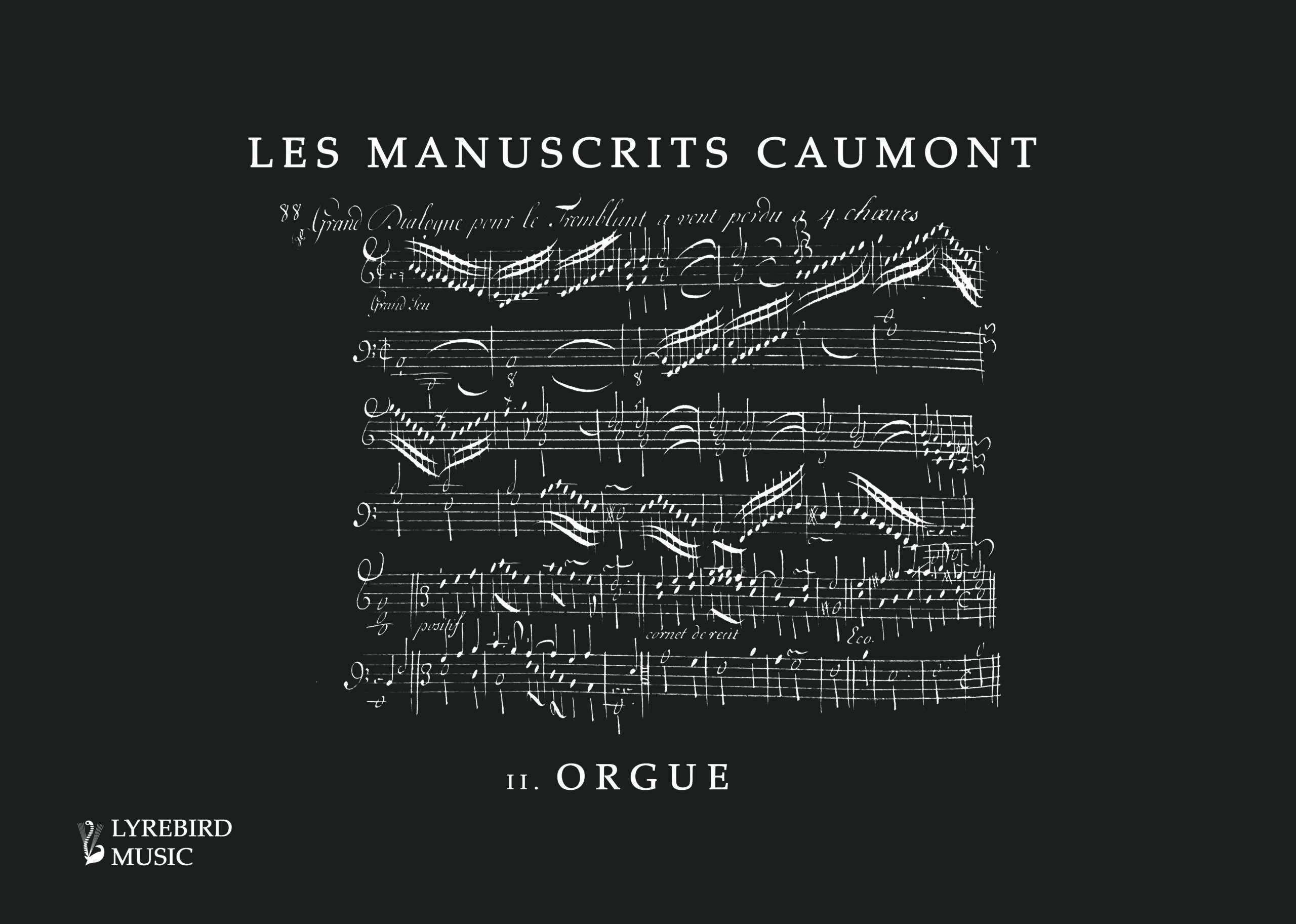
Second revised and expanded edition of one of the most important surviving collections of French organ music from the Grand Siècle. Preserved in a luxurious manuscript dated 1707, Le Manuscrit Caumont : II. Orgue contains 111 versets in the French liturgical tradition, including many unique and previously unknown works closely linked to Jacques Boyvin and the Norman organ school. Edited by Jon Baxendale, this companion volume to Le Manuscrit Caumont : I. Clavecin includes a substantial bilingual preface exploring the manuscript, its sources and seventeenth-century French performance practice.
ISBN: 978-1-917401-50-0 (Hardback) | 978-1-917401-49-4 (Wire)
Edited by Jon Baxendale
- A new and exciting discovery of known and unica French organ music from 1706
- Bilingual preface in English and French
- Detailed preface containing information on the manuscript, its music and performance
- Full critical commentary
- Three available formats
- Colour hardback cover with a matt finish (choice on checkout)
- Wire-bound with soft colour cover (choice on checkout)
- Tablet (PDF – one download available for 5 days)
Prices vary according to your needs. Please first choose the format you require.
Please note that if you are an EU customer, the prices include the VAT for your area. This is collected for orders under €150. EU customers whose orders exceed €150 will see the VAT until checkout, at which point taxes will be removed.
 Le Manuscrit Caumont –– Clavecin presents one of the most important discoveries in seventeenth-century French keyboard music in recent decades. Preserved in a private collection and named after the harpsichordist Catherine Caumont, the manuscript contains an extraordinary anthology of 156 works copied around 1700, including 85 harpsichord pieces and 71 transcriptions from French opera, the majority drawn from the works of Lully.
Edited by Denis Herlin, a renowned scholar in the field of French Baroque harpsichord music, the volume offers a major new study of this remarkable source. Beautifully copied by a single scribe and closely connected to a companion organ manuscript, the collection provides an exceptional window into the musical culture of late seventeenth-century France. Alongside works by Chambonnières, Louis Couperin, d’Anglebert, Lebègue, Hardel, Jacquet de La Guerre and Thomelin are dozens of anonymous pieces, unique versions, previously unknown variants and an unparalleled collection of operatic transcriptions.
Particularly remarkable is the manuscript’s organisation by key and the vast series of overtures, chaconnes and dances drawn from the French stage. Many of these arrangements are unica, surviving nowhere else. The manuscript also preserves rare evidence concerning ornamentation, notation, pedagogy and performance practice, including distinctive signs for coulé, port de voix and double cadences.
Research further suggests links with Rouen and the circle of Jacques Boyvin, raising fascinating questions concerning the transmission of French keyboard repertory outside Paris and the relationship between harpsichordists and the operatic world of the Académie royale de musique.
Le Manuscrit Caumont –– Clavecin stands today as a major witness to the richness, diversity and sophistication of French harpsichord culture at the end of the Grand Siècle.
Le Manuscrit Caumont –– Clavecin présente l’une des découvertes les plus importantes de ces dernières décennies dans le domaine de la musique française pour clavier du XVIIe siècle. Conservé dans une collection privée et nommé d’après la claveciniste Catherine Caumont, le manuscrit renferme une extraordinaire anthologie de 156 œuvres copiées vers 1700, comprenant 85 pièces pour clavecin et 71 transcriptions tirées de l’opéra français, dont la majorité provient des œuvres de Lully.
Édité par Denis Herlin, spécialiste reconnu de la musique française pour clavecin à l’époque baroque, ce volume offre une étude majeure de cette source remarquable. Magnifiquement copié par une seule main et étroitement lié à un manuscrit d’orgue compagnon, le recueil constitue un témoignage exceptionnel sur la culture musicale de la fin du XVIIe siècle en France. Aux côtés d’œuvres de Chambonnières, Louis Couperin, d’Anglebert, Lebègue, Hardel, Jacquet de La Guerre et Thomelin figurent des dizaines de pièces anonymes, des versions uniques, des variantes jusqu’alors inconnues ainsi qu’un ensemble sans équivalent de transcriptions d’opéras.
Particulièrement remarquable est l’organisation du manuscrit par tonalité et la vaste série d’ouvertures, de chaconnes et de danses issues de la scène lyrique française. Nombre de ces arrangements sont des unica, ne survivant dans aucune autre source connue. Le manuscrit conserve également de précieux témoignages concernant l’ornementation, la notation, la pédagogie et les pratiques d’exécution, notamment à travers des signes distinctifs pour le coulé, le port de voix et les doubles cadences.
Les recherches suggèrent en outre des liens avec Rouen et le cercle de Jacques Boyvin, soulevant des questions fascinantes sur la transmission du répertoire français pour clavier hors de Paris et sur les relations entre les clavecinistes et le monde de l’Académie royale de musique.
Le Manuscrit Caumont –– Clavecin apparaît aujourd’hui comme un témoin majeur de la richesse, de la diversité et du raffinement de la culture française du clavecin à la fin du Grand Siècle.
Organists' Review: June 2022
Early Music Reviews: April 2022
This Lyrebird Music edition brings to life an important manuscript of French Classical organ music dated 1707. Its earlier provenance is unknown until it appeared in an auction in Normandy from where it passed on to an antique dealer in Amiens. It was bought from there in 2008 by the current owner, whose name has been attached to what is now known as Le Manuscrit Caumont. Very sensibly, given the quality of his other Lyrebird Music editions, the owner asked Jon Baxendale to research and edit the manuscript and produce this splendid edition.
The manuscript contains 111 pieces of organ music intended for use during the French Catholic liturgy with its use of alternatim, where verses of Mass and other settings were alternately either sung or played on the organ. Some of the pieces can be identified with known composers such as Boyvin, Lebegue, Nivers, Raison and Thomelin, but around 80 pieces are unique to this manuscript. In a very well-presented argument in the detailed preface, editor Jon Baxendale proposes Jacques Boyvin (c1649-1706) as the composer of these 80 pieces, adding to the 25 pieces that have versions in his two published books of organ works (1689 and 1700). The manuscript was possibly copied from a manuscript that Boyvin put together, which would explain why so many of his own pieces did not have his own name attached. Boyvin was born in Paris but spent the bulk of his career as organist of Rouen Cathedral, a successor to the famed Jean Titelouze from around 40 years earlier. He supervised the 1689 rebuilding of the four-manual Clicquot cathedral organ.
The manuscript is unusual compared to other organ books of the period in that the pieces are not arranged in any liturgical form, but are roughly in order of the genre of the pieces. The opening four Preludes are following by groups of pieces with titles of, for example, Fugue grave, Duo, Basse de Trompette, Dialogue. They are all in the church tones V and VI, suggesting the original presence of further volumes using the other tones. The length of the pieces varies from a few bars to 172 bars for the single named Offertory – the Grand Dialogue a trois ou quatre Chœurs avec le Tremblant a vent perdu.
The substantial preface explores the manuscript and its music and discusses such important performance issues as registration, fingering, notes inégales and ornamentation using sources contemporary to the manuscript itself. The notes on performance include the preface to Boyvin’s own 1680 organ book (with English translation), and includes the specification of his own Rouen organ. A section on the liturgical context of the music is included, with Nivers’ description of the use of the organ in the liturgy. A Critical Commentary includes notes on individual pieces as well as details of the variants between these pieces and other printed sources. The manuscript is remarkably accurate in terms of notes, so editorial amendments are minimal and clearly indicated. Ease of page turns is taken into account where possible.
As with other Lyrebird Music publications, the musical type is beautifully clear to read. It is in landscape format, and is available in English and French versions, and in hardback or wire-binding. The hardback version doesn’t take too much persuasion to lay flat on the music desk. The ISMN references for the French edition are 979-0-706670-19-5 (French hardback) and 979-0-706670-40-9 (French softback wire).
This is the first of two Caumont manuscripts, the other being a book of harpsichord pieces in the same hand, much of which is also unknown. It will be published later this year.
Andrew Benson-Wilson
Early Music Reviews
LBMP–079: Les Manuscrits Caumont: II Orgue (Second Edition)
From €38.00
Second revised and expanded edition of one of the most important surviving collections of French organ music from the Grand Siècle. Preserved in a luxurious manuscript dated 1707, Le Manuscrit Caumont : II. Orgue contains 111 versets in the French liturgical tradition, including many unique and previously unknown works closely linked to Jacques Boyvin and the Norman organ school. Edited by Jon Baxendale, this companion volume to Le Manuscrit Caumont : I. Clavecin includes a substantial bilingual preface exploring the manuscript, its sources and seventeenth-century French performance practice.
ISBN: 978-1-917401-50-0 (Hardback) | 978-1-917401-49-4 (Wire)
Edited by Jon Baxendale
- A new and exciting discovery of known and unica French organ music from 1706
- Bilingual preface in English and French
- Detailed preface containing information on the manuscript, its music and performance
- Full critical commentary
- Three available formats
- Colour hardback cover with a matt finish (choice on checkout)
- Wire-bound with soft colour cover (choice on checkout)
- Tablet (PDF – one download available for 5 days)
Prices vary according to your needs. Please first choose the format you require.
Please note that if you are an EU customer, the prices include the VAT for your area. This is collected for orders under €150. EU customers whose orders exceed €150 will see the VAT until checkout, at which point taxes will be removed.
Le Manuscrit Caumont –– Clavecin presents one of the most important discoveries in seventeenth-century French keyboard music in recent decades. Preserved in a private collection and named after the harpsichordist Catherine Caumont, the manuscript contains an extraordinary anthology of 156 works copied around 1700, including 85 harpsichord pieces and 71 transcriptions from French opera, the majority drawn from the works of Lully.
Edited by Denis Herlin, a renowned scholar in the field of French Baroque harpsichord music, the volume offers a major new study of this remarkable source. Beautifully copied by a single scribe and closely connected to a companion organ manuscript, the collection provides an exceptional window into the musical culture of late seventeenth-century France. Alongside works by Chambonnières, Louis Couperin, d’Anglebert, Lebègue, Hardel, Jacquet de La Guerre and Thomelin are dozens of anonymous pieces, unique versions, previously unknown variants and an unparalleled collection of operatic transcriptions.
Particularly remarkable is the manuscript’s organisation by key and the vast series of overtures, chaconnes and dances drawn from the French stage. Many of these arrangements are unica, surviving nowhere else. The manuscript also preserves rare evidence concerning ornamentation, notation, pedagogy and performance practice, including distinctive signs for coulé, port de voix and double cadences.
Research further suggests links with Rouen and the circle of Jacques Boyvin, raising fascinating questions concerning the transmission of French keyboard repertory outside Paris and the relationship between harpsichordists and the operatic world of the Académie royale de musique.
Le Manuscrit Caumont –– Clavecin stands today as a major witness to the richness, diversity and sophistication of French harpsichord culture at the end of the Grand Siècle.
Le Manuscrit Caumont –– Clavecin présente l’une des découvertes les plus importantes de ces dernières décennies dans le domaine de la musique française pour clavier du XVIIe siècle. Conservé dans une collection privée et nommé d’après la claveciniste Catherine Caumont, le manuscrit renferme une extraordinaire anthologie de 156 œuvres copiées vers 1700, comprenant 85 pièces pour clavecin et 71 transcriptions tirées de l’opéra français, dont la majorité provient des œuvres de Lully.
Édité par Denis Herlin, spécialiste reconnu de la musique française pour clavecin à l’époque baroque, ce volume offre une étude majeure de cette source remarquable. Magnifiquement copié par une seule main et étroitement lié à un manuscrit d’orgue compagnon, le recueil constitue un témoignage exceptionnel sur la culture musicale de la fin du XVIIe siècle en France. Aux côtés d’œuvres de Chambonnières, Louis Couperin, d’Anglebert, Lebègue, Hardel, Jacquet de La Guerre et Thomelin figurent des dizaines de pièces anonymes, des versions uniques, des variantes jusqu’alors inconnues ainsi qu’un ensemble sans équivalent de transcriptions d’opéras.
Particulièrement remarquable est l’organisation du manuscrit par tonalité et la vaste série d’ouvertures, de chaconnes et de danses issues de la scène lyrique française. Nombre de ces arrangements sont des unica, ne survivant dans aucune autre source connue. Le manuscrit conserve également de précieux témoignages concernant l’ornementation, la notation, la pédagogie et les pratiques d’exécution, notamment à travers des signes distinctifs pour le coulé, le port de voix et les doubles cadences.
Les recherches suggèrent en outre des liens avec Rouen et le cercle de Jacques Boyvin, soulevant des questions fascinantes sur la transmission du répertoire français pour clavier hors de Paris et sur les relations entre les clavecinistes et le monde de l’Académie royale de musique.
Le Manuscrit Caumont –– Clavecin apparaît aujourd’hui comme un témoin majeur de la richesse, de la diversité et du raffinement de la culture française du clavecin à la fin du Grand Siècle.
Organists' Review: June 2022
Early Music Reviews: April 2022
This Lyrebird Music edition brings to life an important manuscript of French Classical organ music dated 1707. Its earlier provenance is unknown until it appeared in an auction in Normandy from where it passed on to an antique dealer in Amiens. It was bought from there in 2008 by the current owner, whose name has been attached to what is now known as Le Manuscrit Caumont. Very sensibly, given the quality of his other Lyrebird Music editions, the owner asked Jon Baxendale to research and edit the manuscript and produce this splendid edition.
The manuscript contains 111 pieces of organ music intended for use during the French Catholic liturgy with its use of alternatim, where verses of Mass and other settings were alternately either sung or played on the organ. Some of the pieces can be identified with known composers such as Boyvin, Lebegue, Nivers, Raison and Thomelin, but around 80 pieces are unique to this manuscript. In a very well-presented argument in the detailed preface, editor Jon Baxendale proposes Jacques Boyvin (c1649-1706) as the composer of these 80 pieces, adding to the 25 pieces that have versions in his two published books of organ works (1689 and 1700). The manuscript was possibly copied from a manuscript that Boyvin put together, which would explain why so many of his own pieces did not have his own name attached. Boyvin was born in Paris but spent the bulk of his career as organist of Rouen Cathedral, a successor to the famed Jean Titelouze from around 40 years earlier. He supervised the 1689 rebuilding of the four-manual Clicquot cathedral organ.
The manuscript is unusual compared to other organ books of the period in that the pieces are not arranged in any liturgical form, but are roughly in order of the genre of the pieces. The opening four Preludes are following by groups of pieces with titles of, for example, Fugue grave, Duo, Basse de Trompette, Dialogue. They are all in the church tones V and VI, suggesting the original presence of further volumes using the other tones. The length of the pieces varies from a few bars to 172 bars for the single named Offertory – the Grand Dialogue a trois ou quatre Chœurs avec le Tremblant a vent perdu.
The substantial preface explores the manuscript and its music and discusses such important performance issues as registration, fingering, notes inégales and ornamentation using sources contemporary to the manuscript itself. The notes on performance include the preface to Boyvin’s own 1680 organ book (with English translation), and includes the specification of his own Rouen organ. A section on the liturgical context of the music is included, with Nivers’ description of the use of the organ in the liturgy. A Critical Commentary includes notes on individual pieces as well as details of the variants between these pieces and other printed sources. The manuscript is remarkably accurate in terms of notes, so editorial amendments are minimal and clearly indicated. Ease of page turns is taken into account where possible.
As with other Lyrebird Music publications, the musical type is beautifully clear to read. It is in landscape format, and is available in English and French versions, and in hardback or wire-binding. The hardback version doesn’t take too much persuasion to lay flat on the music desk. The ISMN references for the French edition are 979-0-706670-19-5 (French hardback) and 979-0-706670-40-9 (French softback wire).
This is the first of two Caumont manuscripts, the other being a book of harpsichord pieces in the same hand, much of which is also unknown. It will be published later this year.
Andrew Benson-Wilson
Early Music Reviews